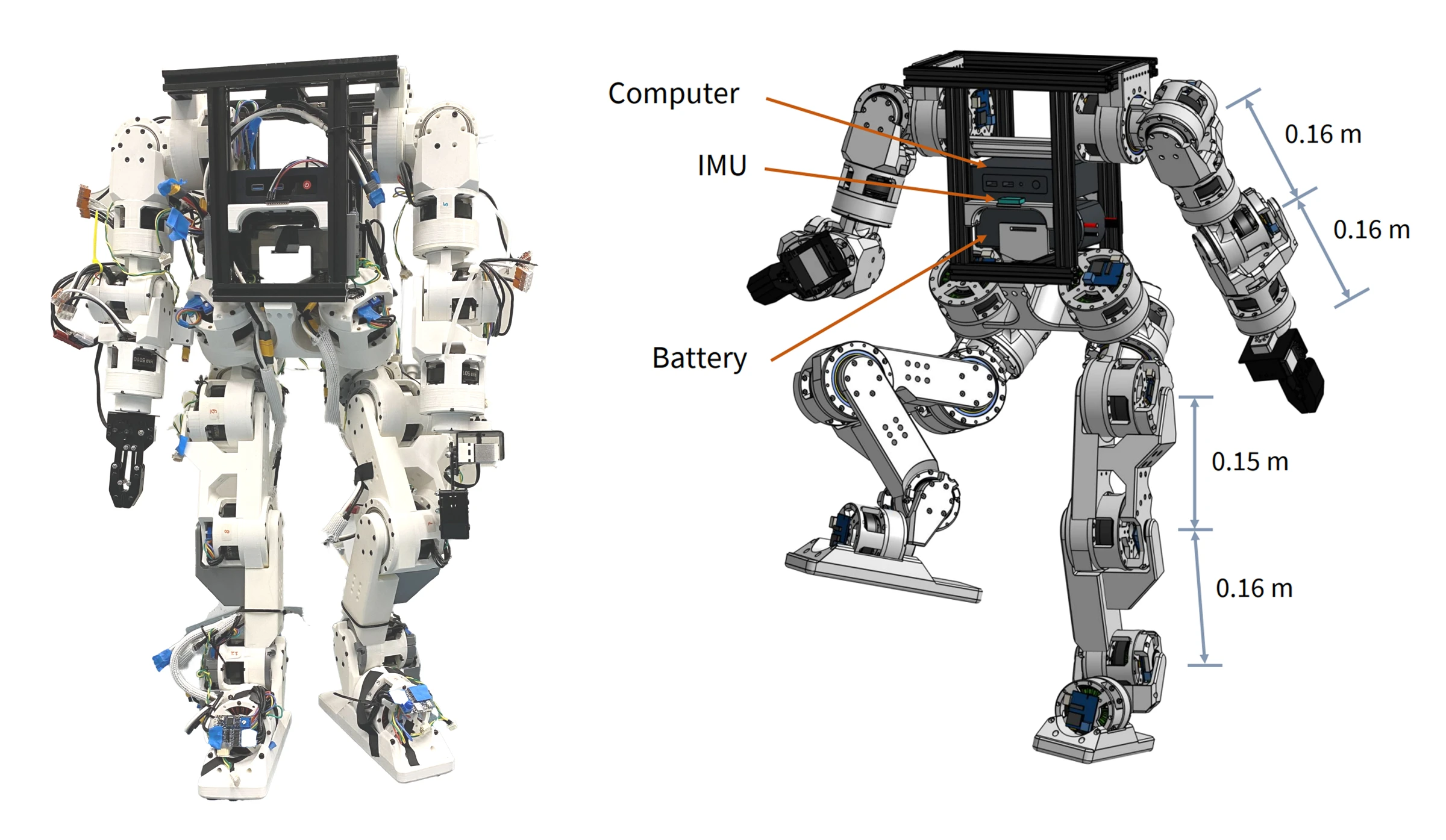
From hardware and control to action models.
OpenLoong and Berkeley Humanoid Lite provide public hardware or control resources. NVIDIA GR00T and Gemini Robotics address mappings between vision, language and action. GR00T offers model and code resources; Gemini Robotics provides official demonstrations and testing programmes, while its ER model exposes embodied-reasoning interfaces. First identify whether a resource concerns mechanism design, motion control or task understanding.
What would transfer require?
Applying whole-body control or learned policies to continuum, snake or miniature robots calls for a fresh examination of degrees of freedom, actuation, observations and contact models. Transfer should be tested with explicit tasks, baselines and experimental conditions.
From public material to reproducible research.
A demonstration shows behaviour; code allows inspection of an implementation; data and experiment descriptions support replication. These are different forms of evidence. Tesla’s official demonstrations document industry progress, while open hardware and learning frameworks offer starting points for experiments. A defined task provides a clearer basis for deciding which methods may transfer than appearance alone.
Sources
- OpenLoong · 青龙 / Qinglong
- OpenLoong · 文档中心 / Documents
- OpenLoong · Dynamics control
- Berkeley Humanoid Lite
- NVIDIA Isaac GR00T
- Google DeepMind · Gemini Robotics
- Google DeepMind · Gemini Robotics ER
- Tesla · AI / Optimus
Factual descriptions refer to the listed public sources. Method transfer and further research questions are editorial discussion.